Views: 0 Author: Site Editor Publish Time: 2026-04-15 Origin: Site
Table of Contents
In the rapidly evolving landscape of electrical engineering and industrial automation, the demand for precision is at an all-time high. Whether it is the safety lock on a microwave door or the complex control system of an Electric Vehicle (EV) charging station, one tiny component ensures everything runs smoothly: the microswitch.
Precision, reliability, and lightning-fast response are the hallmarks of modern electronic systems. To achieve these, engineers rely on microswitches due to their unique "snap-action" capability. Despite their compact size, they are essential in ensuring safety, control, and operational efficiency across thousands of industries. If you are looking for high-performance components, explore our full range of professional microswitch products designed for durability and accuracy.
A microswitch, technically termed a miniature snap-action switch, is an electromechanical device that is actuated by very little physical force through the use of a tipping-point mechanism. This mechanism, often referred to as an "over-center" design, allows the switch to change states almost instantaneously.
The term "micro" refers to the small gap between the contacts (often as small as 0.25mm to 1mm) and the small movement required to trigger the switch. Unlike a standard toggle switch where the movement of the contacts is proportional to the movement of the handle, the microswitch uses an internal spring to ensure that the speed of the contact transition is independent of the speed of the actuator movement.
Pro Tip: This rapid transition minimizes electrical arcing, which significantly extends the electrical life of the switch and prevents contact welding under high loads.
Minimal Operating Force: Some models can be triggered by a force as low as a few grams.
High Repeatability: The switch consistently triggers at the exact same physical point (Differential Travel).
Exceptional Durability: Mechanical life often exceeds 10 million cycles.
Versatile Configurations: Available in SPDT, SPST-NO, and SPST-NC setups.
The core of a microswitch is its mechanical snap-action mechanism. To understand its efficiency, one must look at the "over-center" principle. Inside the housing, there is a flat spring supported by a terminal. When the actuator—be it a button or a lever—is pressed, it applies pressure to this internal spring.
As the force increases, the spring stores potential energy. Once the actuator reaches a specific "trip point," the spring snaps the contacts from one position to the other (e.g., from Normally Closed to Normally Open). This transition happens in milliseconds, ensuring a clean break or make of the electrical circuit.
Every reliable microswitch consists of four primary parts:
Actuator: The part that receives external force (plunger, lever, or roller).
Spring Mechanism: The heart of the snap-action, usually made of high-grade beryllium copper or stainless steel.
Electrical Contacts: Often plated with silver or gold to ensure high conductivity and corrosion resistance.
Housing: A robust plastic or ceramic casing that protects the internals from dust and moisture.
For a deep dive into the engineering specs, you can refer to our technical breakdown of real product structures.
Because microswitches are used in everything from medical devices to aerospace, they come in a vast array of physical configurations. Selecting the right type depends on how the mechanical force is applied.
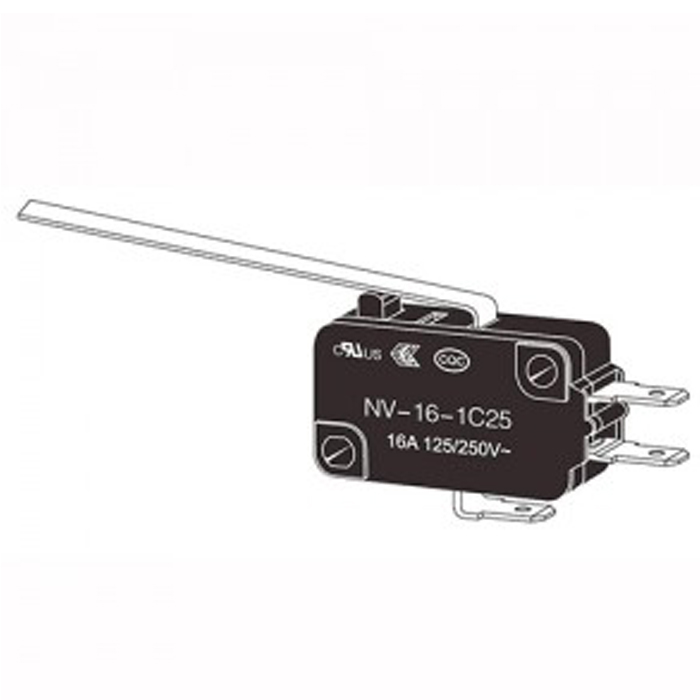
Lever Microswitches: These are the most common in industrial settings. The lever acts as a fulcrum, allowing a very small force to trigger the switch. They are perfect for detecting the presence of objects on a conveyor belt. Discover our industrial lever microswitch models for heavy-duty use.
Roller Microswitches: Equipped with a small wheel at the end of the lever, these are designed for applications where the actuator is triggered by a cam or a moving mechanical slide. This reduces friction and prevents wear on the switch. View the high-precision roller microswitch collection.
Push Button Microswitches: Typically found in consumer electronics and control panels where a direct, perpendicular push is required. Explore our tactile push button microswitches.
SPDT (Single Pole Double Throw): This configuration features three terminals: Common (COM), Normally Open (NO), and Normally Closed (NC). It allows the switch to control two different circuits or choose between two states. Our SPDT microswitches are the industry standard for flexibility.
Heavy-Duty Variants: For applications involving high current or high voltage, standard microswitches might fail. Heavy-duty versions are reinforced to handle electrical surges without degradation. See the high-load heavy-duty microswitch series.
Many engineers use the terms "Microswitch" and "Limit Switch" interchangeably, but they serve different environments. A microswitch is usually a component inside a larger system, while a limit switch is often a standalone, ruggedized device meant for harsh environments.
Feature | Microswitch | Limit Switch |
|---|---|---|
Physical Size | Sub-miniature to Miniature | Large and Rugged |
Operating Precision | Extremely High (Microns) | Moderate to High |
Environmental Protection | Requires external housing or IP67 rating | Usually IP65-IP68 (Industrial Ready) |
Switching Speed | Fast (Snap-action) | Moderate |
Cost | Lower per unit | Higher due to housing |
The versatility of the microswitch makes it one of the most successful electronic components in history. Here is how they are utilized across various sectors:
Microswitches act as safety interlocks. In a microwave, they ensure the device won't start unless the door is fully latched. In washing machines, they detect door closure and water level limits. They provide the "click" and the logic that keeps your home safe.
In factories, microswitches are used in control panels, conveyor systems, and as safety stops for robotic arms. They ensure that a machine knows exactly when a part has arrived or when a safety gate has been opened. For these demanding environments, we recommend the NV-21Z1 industrial microswitch.
Your car is filled with microswitches. They detect if your seatbelt is buckled, if your door is ajar, and they trigger your brake lights. In modern vehicles, they are also part of the electronic parking brake system. Check out our automotive-certified switches for high-vibration resistance.
As the world shifts to green energy, microswitches have found a home in EV charging guns. They detect when the nozzle is correctly inserted into the vehicle and signal the system to begin or end the charging process safely. To support your EV designs, explore our advanced relay and switch solutions.
Choosing a switch isn't just about size. You must evaluate the electrical and mechanical stresses it will face.
Electrical Load: Determine if you are switching AC or DC, and the total Amperage. For high-current needs, look at our specialized high-current models.
Operating Force (OF): How much physical pressure is available in your design? Choosing a switch with an OF that is too high will lead to system failure.
Environmental Resistance: If the switch is exposed to water, oil, or dust, you must choose an IP67-rated sealed microswitch.
Contact Material: Gold contacts are best for low-current (logic level) signals, while silver is better for power switching.
You can browse our full catalog to filter by these specific parameters.
Even the most reliable microswitch can fail under extreme conditions. Here is how to diagnose and fix them:
Problem: Intermittent Signal. Often caused by loose terminals or oxidation. Solution: Check wiring and ensure you are using gold-plated contacts for low-voltage applications.
Problem: Switch Stuck in One Position. This usually indicates contact welding or a broken internal spring. Solution: Replace the switch and check if the electrical load exceeds the rated capacity.
Problem: Mechanical Fatigue. The actuator no longer reaches the trip point. Solution: Ensure the mechanical strike is within the specified over-travel limits to prevent over-stressing the spring.
Q: How many cycles can a microswitch last?
A: High-quality microswitches, like those from NiceRelay, are rated for 1 million to 10 million mechanical operations.
Q: Can a microswitch handle 220V AC?
A: Yes, many models are rated for 250V AC, but always verify the Amperage rating on the datasheet.
Q: Are microswitches waterproof?
A: Standard models are not, but specialized "sealed" microswitches are available with IP67 ratings for wet environments.
Need technical support or a custom quote for your microswitch project? Our team of experts is ready to assist you.
Email: sales@nicerelay.com Official Website: www.nicerelay.com